
Air Conditioner Not Cooling in a Rental Unit: Who Has to Repair It?
As a general rule, the landlord must repair an air conditioner that breaks down during the lease. The tenant handles routine maintenance and minor repairs, such as cleaning the filter. If the lease says otherwise, check those clauses as well.
Section 550 of the Civil and Commercial Code makes the landlord liable for defects that arise during the lease. The landlord must also carry out necessary repairs, except repairs that the law or custom requires the tenant to do. A lease requiring the tenant to “maintain” the property does not mean the tenant must make every repair (Supreme Court Judgment No. 1471/2548 (2005)).
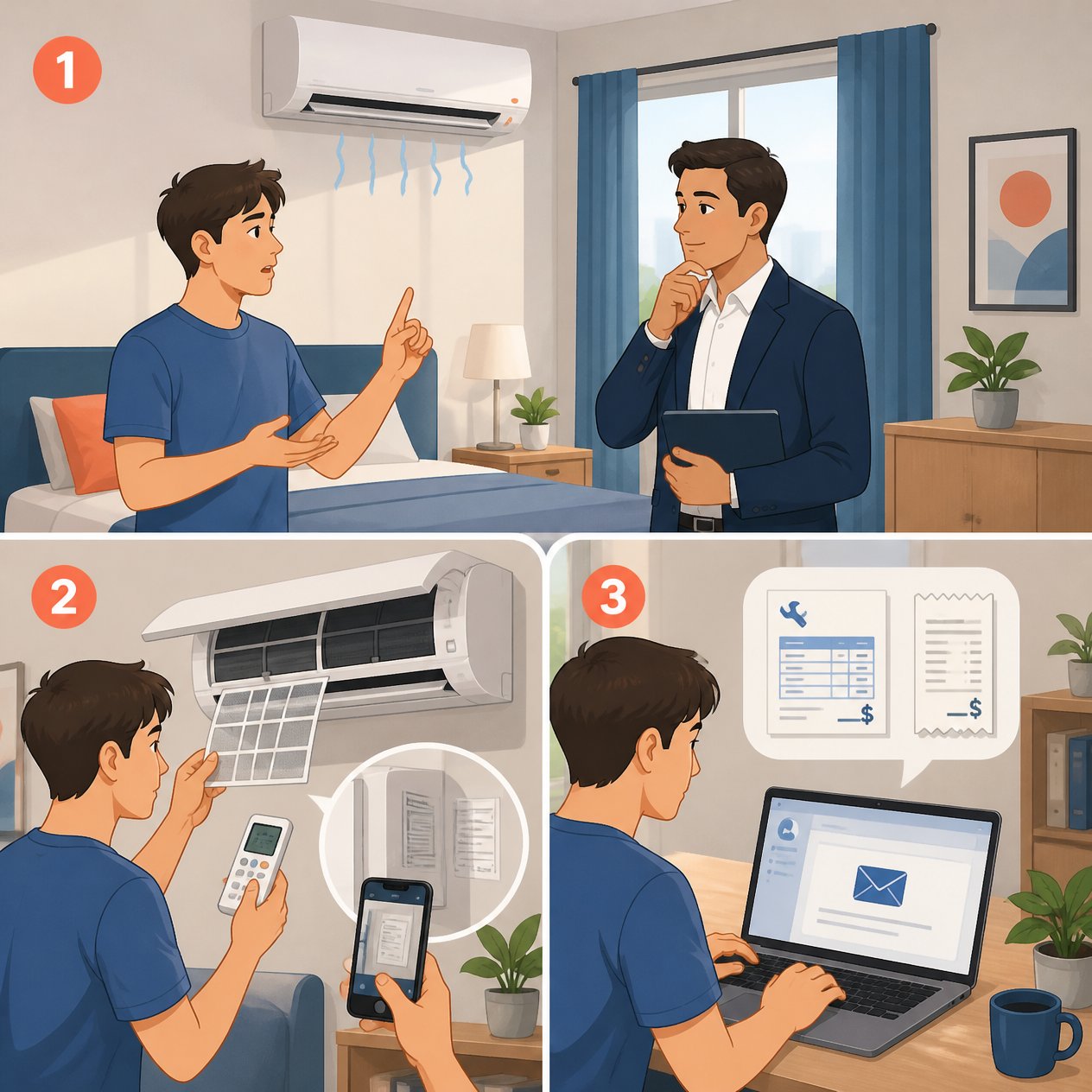
In practice, there are 3 things to do right away:
Notify the unit owner in writing before hiring a technician yourself.
Take photos or videos of the problem, and of the AC’s brand and model label, as evidence.
Keep every quotation and receipt.
This article is general information, not legal advice. Last updated October 27, 2026.
Why the AC Isn’t Cooling, and What to Check Before Requesting a Repair
According to Midea’s article on the causes, most cases of an AC not cooling come down to 5 causes. Tenants can realistically handle only the filter and the settings themselves. A technician should check the rest.
Symptom | Common cause | Can the tenant check it? |
|---|---|---|
Weak airflow, room not evenly cooled | Air filter clogged with dust | Yes. Remove the filter, wash it with clean water, and let it dry fully before putting it back. Do this at least once a month. |
Blows air but isn’t cold; ice on the copper pipes or water dripping around the unit | Refrigerant low or leaking | No. A technician needs to measure the pressure and find the leak. |
Room doesn’t cool even though the AC is running | Outdoor condenser coil dirty or fins bent | Don’t climb up to fix it yourself, especially in a condo. Notify the unit owner or building management (juristic person). A technician should deep-clean it 1–2 times a year. |
Unusual noise, unit keeps cutting on and off | Compressor or capacitor problem | No. It involves the electrical system, so a technician should check it. |
Alternates between cool and warm, stops before reaching the set temperature | Faulty temperature sensor | You can only check that the sensor isn’t in direct sunlight or near a heat source. Leave the rest to a technician. |
Before requesting a repair, check 3 basic usage items. Make sure the AC is set to Cool mode, the doors and windows are fully closed, and the remote has enough battery. If it still isn’t cooling, record the symptoms and notify the unit owner.
This table covers only the causes and what tenants can do themselves. The next section covers who pays for repairs.
Who Has to Repair It: Case by Case
If the AC deteriorates or breaks down on its own during the lease, repairs are the landlord’s responsibility. The cost of routine maintenance falls on the tenant. This table summarizes the general rules and the legal source for each case. Individual leases may say something different.
Case | Who is generally responsible | Source |
|---|---|---|
AC breaks down or deteriorates during the lease, e.g., refrigerant leak, compressor failure | Landlord | Sec. 550 and Supreme Court Judgment 1471/2548 |
AC already broken on move-in day | Landlord, because the property must be handed over in good repair | Sec. 546 |
Cleaning the filter, routine maintenance, minor repairs | Tenant | Sec. 547 and Sec. 553, as cited in Supreme Court Judgment 1471/2548 |
Tenant pays upfront for necessary and reasonable repairs | Tenant can claim reimbursement from the landlord, except for routine maintenance and minor repairs | Sec. 547 |
Damage from improper use | Tenant may be liable, depending on the facts and the lease | Consult a professional |
AC the tenant bought and installed themselves | Tenant | It is the tenant’s property |
Lease says the tenant must look after the AC | Follow the lease, but “maintenance” doesn’t cover every major repair | Supreme Court Judgment 1471/2548 |
One thing to watch out for is paying for repairs upfront without notifying the landlord. The landlord may later argue the cost was unnecessary or was only routine maintenance. The Supreme Court has ruled that a tenant who made repairs for their own benefit had no right to reimbursement (Supreme Court Judgment 827/2557 (2014), as cited on the Section 547 page). It’s therefore best to get written consent first.
Steps to Request an AC Repair in a Rental Unit
Requesting a repair takes 6 steps. The key is to give notice in writing and keep evidence of everything.
Do a basic check and gather evidence. Take a video of the symptoms, photograph the brand and model label, and note the date the problem started. Clean the filter first to rule out simple causes.
Review the lease and inventory list. Check what the lease says about the AC, who is responsible for cleaning it, and whether there’s a set channel for repair requests.
Notify the unit owner or building management in writing. Use LINE or email. Describe the symptoms and the date the problem started, and attach photos. A sample message is in the next section.
Wait for a technician sent or approved by the landlord. If you have to hire a technician yourself, get consent and the price in writing first. Keep the quotation and receipt.
Follow up and log all communication. If there’s no response by the time you asked for, send a reminder. Point out the urgency if there are children, elderly people, or anyone ill in the unit.
Keep the close-out documents. Keep the technician’s report, before-and-after photos, and the repair warranty. Then update the unit condition record so it can support your request to get your security deposit back.
Check the AC Before Signing the Lease to Prevent Problems Later
The best way to prevent disputes is to check every AC unit before signing and record its condition in the inventory list. If the AC is already broken at handover, the landlord must hand it over in good repair (Sec. 546).
Run every AC unit for at least 15–20 minutes and confirm the room actually cools down.
Listen to the unit and the compressor for any unusual noise.
Check that no water drips from the unit and there’s no ice on the pipes.
Photograph the label showing the brand, model, and installation year (if there is one).
Ask when the AC was last cleaned.
Specify in the lease who cleans the AC, how many times a year, and who pays for major repairs.
Specify how long the unit owner has to respond after a repair request.
Record the AC’s condition in the inventory list attached to the lease, and have both parties sign it.
Frequently Asked Questions
Who has to repair an AC that isn’t cooling in a rental unit?
Generally, the landlord must repair an AC that breaks down or deteriorates during the lease. The tenant handles routine maintenance and minor repairs. Check your unit’s lease as well.
Do tenants have to clean the AC themselves?
It depends on the lease. Cleaning the filter is routine maintenance that tenants can do themselves. For a full professional cleaning, follow what the lease says. If the lease doesn’t cover it, agree on it with the unit owner in writing.
If I hire a technician myself, can I get my money back from the unit owner?
Yes, for expenses that are necessary and reasonable to preserve the property. This doesn’t include routine maintenance and minor repairs (Sec. 547). Notify the owner and get consent first, and keep your receipts.
Who pays if the AC isn’t cooling because of a refrigerant leak?
Generally it’s the landlord’s responsibility, since it’s a defect in the unit itself. The exception is damage caused by the tenant’s improper use. Ask the technician to state the cause in their report.
What should I do if the unit owner refuses to make repairs?
Send a written message or letter with a deadline, and keep all your evidence. Consult a legal professional before taking further action.
The lease doesn’t mention the AC. What rules apply?
The rules of the Civil and Commercial Code apply, as summarized in the table above. Talk with the unit owner to make things clear, and put any new agreement in writing.


